Temporal Difference Learning
- Definition
- Temporal Difference (TD) Learning updates value estimates using the difference between successive predictions — it learns from incomplete episodes by bootstrapping. S, imagine improving your estimate of running total rewards step-by-step, using your current prediction to update the previous one. TD differs from Monte Carlo methods by updating before the final outcome and from supervised learning by relying on reward signals from interaction.
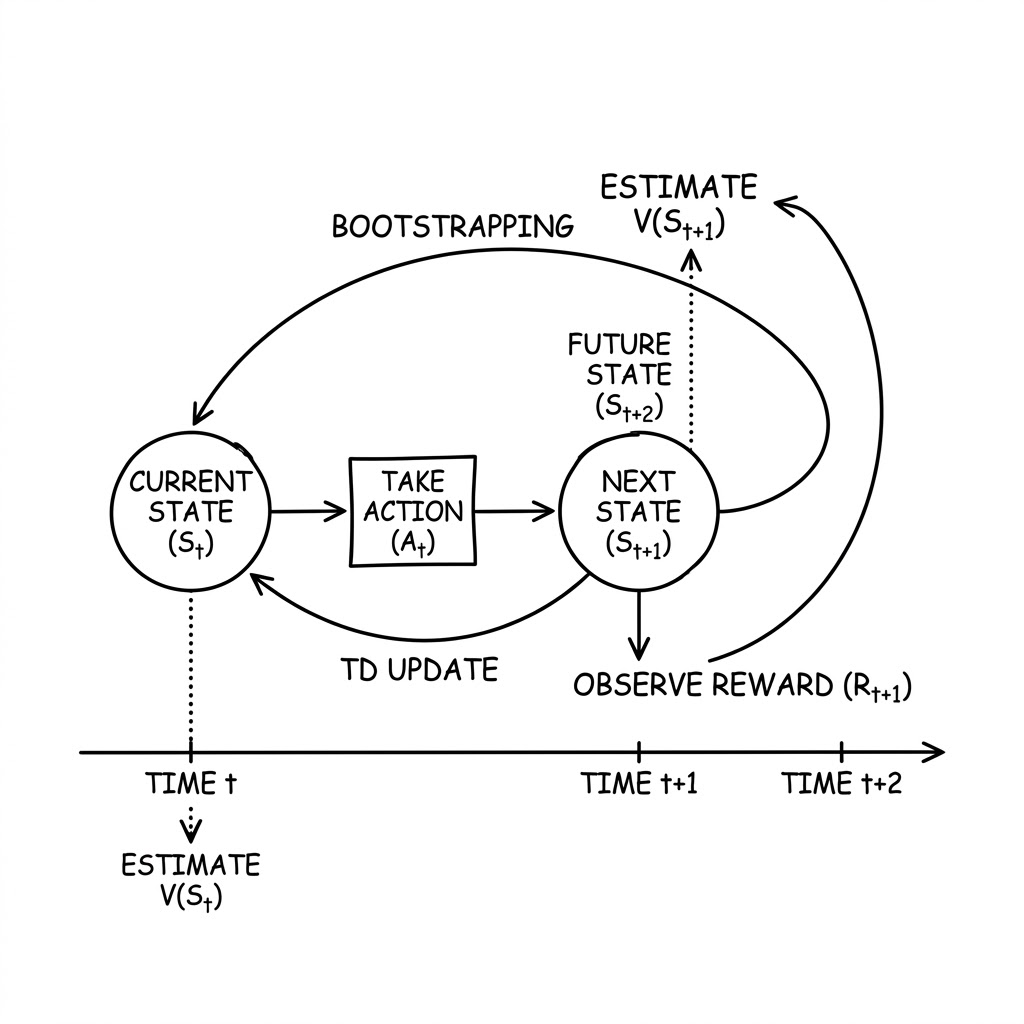
How does it work?
Temporal Difference Learning operates by interacting with an environment: observe state, choose action, receive reward, and update a policy or value estimator. Practical implementations must balance exploration and exploitation and handle credit assignment across time via bootstrapping or Monte Carlo returns.
Examples
- TD(0) for policy evaluation — Estimate state-value functions from bootstrapped returns in episodic tasks.
- Predictive signal in forecasting — Use TD updates to predict future signals with online bootstrapping.
- Combining simulation and real data — Update value estimates online as real interactions arrive in control systems.
Problems
- Sensitive to learning rate and bootstrapping bias
- Can be unstable when combined with function approximation
- Slow convergence in sparse-reward environments
- Correlated updates from sequential data can hurt training stability