DBSCAN
- Definition
- DBSCAN groups points that are densely packed and marks isolated points as noise, without specifying the number of clusters beforehand. Imagine drawing circles and seeing which points have enough neighbors — dense regions become clusters. DBSCAN differs from k-means by handling irregular cluster shapes and identifying outliers, but it requires choosing distance and density thresholds carefully.
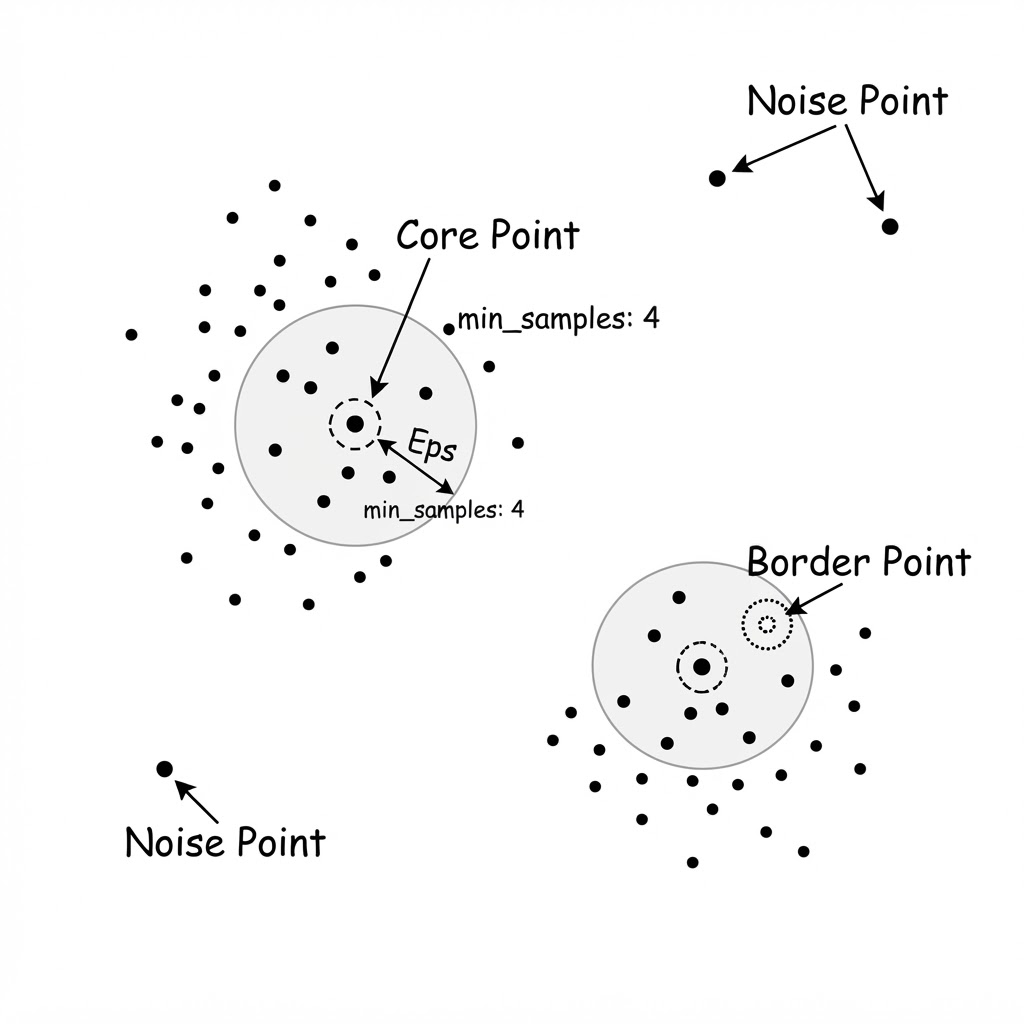
How does it work?
DBSCAN models learn from labeled examples: prepare features, choose a model family, train on examples, and validate on held-out data. Pay attention to data preprocessing, class imbalance, and hyperparameter tuning.
Examples
- Geospatial hotspot detection — Find dense clusters of events (e.g., crime, ride requests) without predefining cluster count.
- Outlier detection in logs — Identify noise points in operational logs as anomalies.
- Discovering dense communities — Cluster social network embeddings where clusters have arbitrary shapes.
Problems
- Sensitive to the epsilon and minPoints parameter choices
- Struggles with clusters of varying density
- Performance degrades in high-dimensional spaces
- Border points can be assigned inconsistently depending on processing order