Association Rule Learning
- Definition
- Association Rule Learning finds rules of the form "if items A and B appear, item C often appears too" — common in market-basket analysis. Imagine mining transaction records to find which products are frequently bought together. It differs from clustering and classification because it discovers co-occurrence rules rather than partitions or labels, and it works well for transactional or binary feature data.
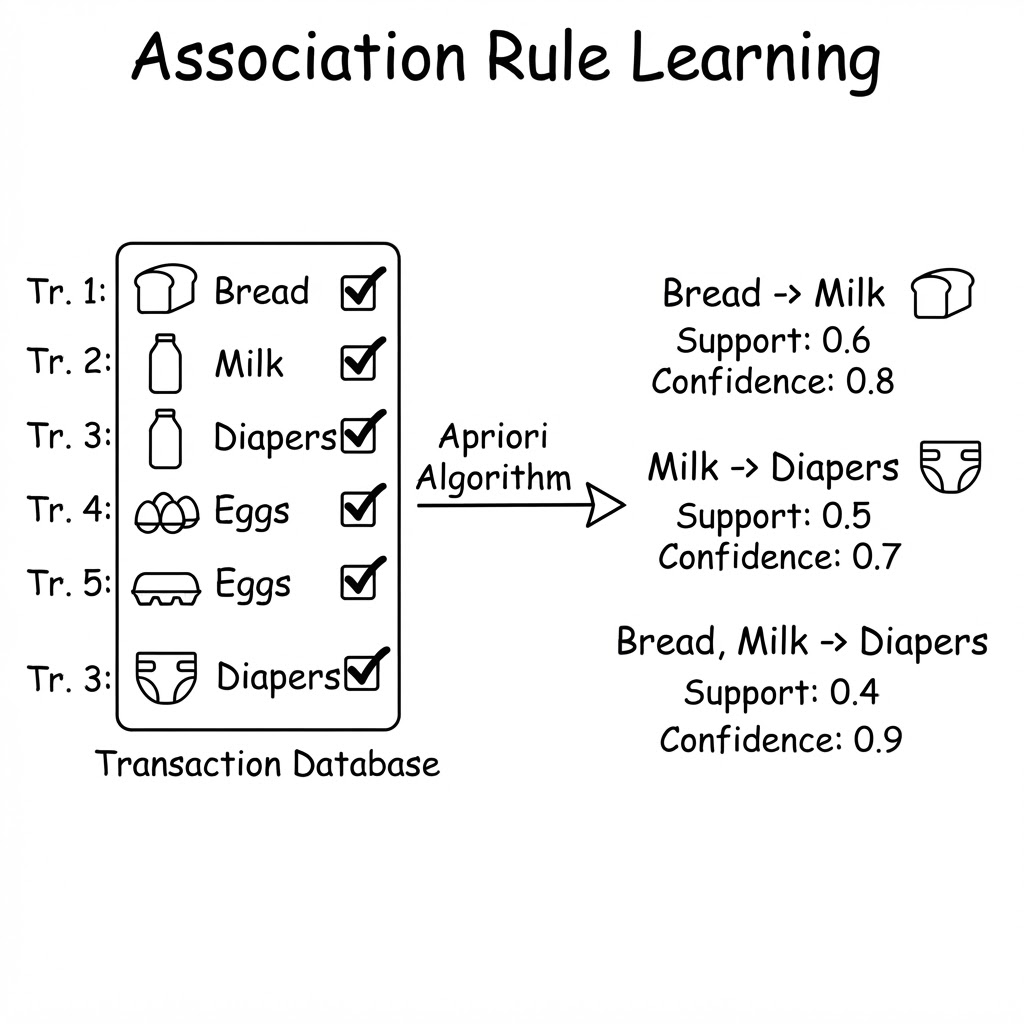
How does it work?
Association Rule Learning models learn from labeled examples: prepare features, choose a model family, train on examples, and validate on held-out data. Pay attention to data preprocessing, class imbalance, and hyperparameter tuning.
Examples
- Market basket analysis — Discover itemsets and association rules (e.g., diapers→baby wipes) for cross-selling.
- Web click pattern mining — Find common navigation sequences to improve site layout.
- Retail promotion planning — Generate rule-based product bundles that co-occur in receipts.
Problems
- Combinatorial explosion of candidate itemsets on large datasets
- Choosing meaningful support/confidence/lift thresholds
- Generates many redundant or spurious rules
- Doesn't scale well to very large or high-dimensional transaction data