Decision Tree Learning
- Definition
- Decision Trees split data by asking sequential yes/no questions to reach a prediction. Each branch tests a feature; leaves hold predictions. Visualize a flowchart that routes each example down to a class or value. Trees differ from black-box models because they are interpretable and easy to inspect. Compared to ensemble methods (random forest, boosting), a single tree is simpler and more prone to overfitting, but it's fast and transparent.
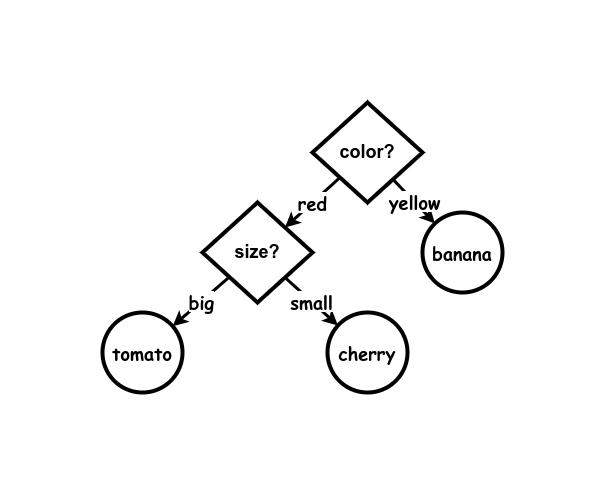
How does it work?
Trees split data by feature thresholds to partition space; ensemble methods build many trees on bootstrapped samples and aggregate predictions. Focus on feature selection, depth control, and understanding variable importance when using these models.
Examples
- Loan approval rules — Learn interpretable decision paths to predict creditworthiness for regulatory reviews.
- Medical triage heuristics — Derive simple rule-based decisions from clinical datasets for initial screening.
- Customer churn segmentation — Identify decision splits that separate high and low churn probability groups.
Problems
- Prone to overfitting without pruning
- High variance — small data changes can produce very different trees
- Biased splits toward features with many distinct values
- Struggles to capture linear relationships efficiently
When should you use it?
- If your data is structured and consists of scalar values
- If you want to create a classifier based on labeled sample data
- If you need your system to be transparent about the decisions it makes
Decision Tree Learning may be faster and easier than a neural network in some cases.