Semantic Network
- Definition
- A Semantic Network represents knowledge as nodes (concepts) connected by labeled relationships, forming a graph you can query and reason over. Picture a mind map where concepts link with typed edges like "is-a" or "part-of." It differs from tabular data representations by emphasizing relationships and from purely statistical embeddings by being explicit and interpretable.
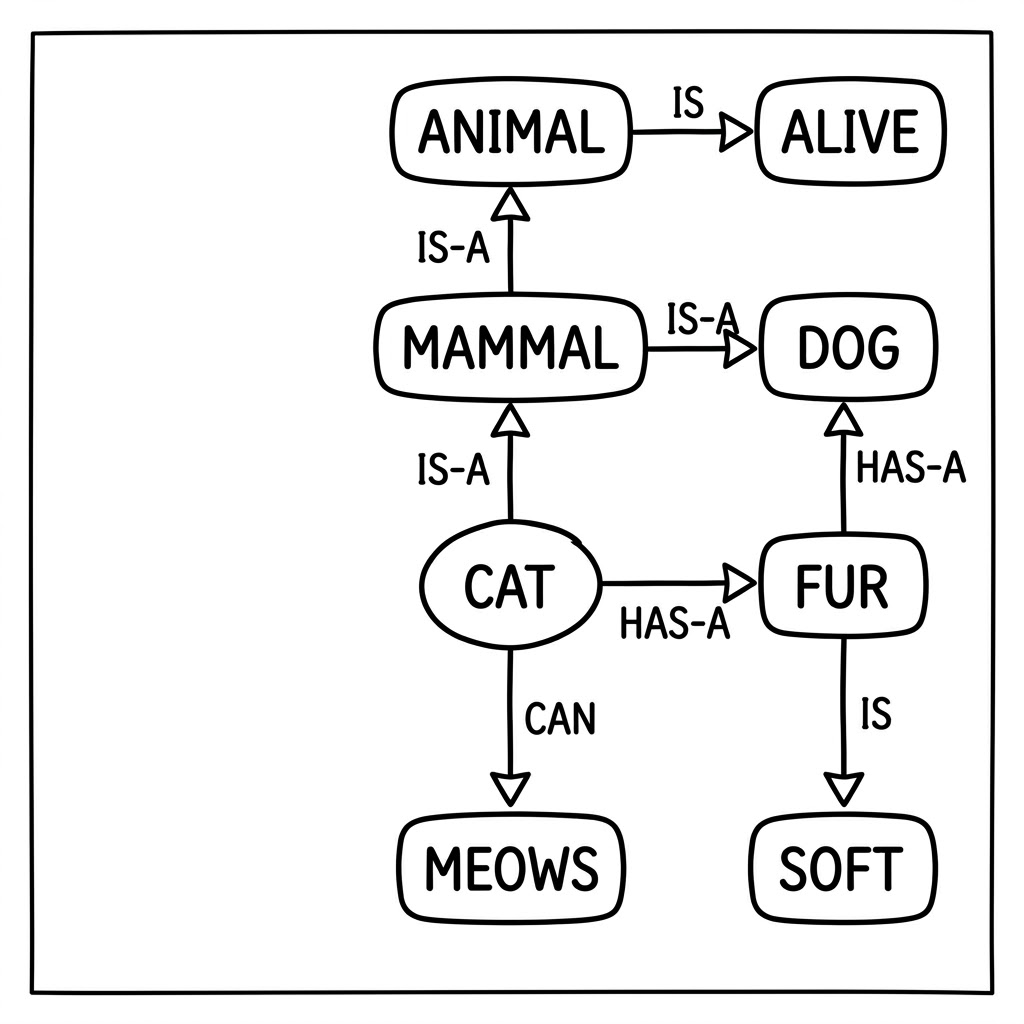
How does it work?
Semantic Network methods manipulate symbols or rules: represent knowledge explicitly, and apply inference algorithms (forward/backward chaining, constraint propagation, search). Implementations focus on rule ordering, conflict resolution, and efficient indexing of facts.
Examples
- Knowledge graphs for QA — Represent entities and relations to answer factual queries in enterprise search.
- Ontology-driven recommendations — Use typed relationships to infer related products or concepts.
- Entity linking — Map text mentions to graph nodes to support downstream NLP tasks.
Problems
- Manually building and maintaining the network is labor-intensive
- Ambiguity in relationship semantics between nodes
- Scaling to very large knowledge bases without inconsistency
- No built-in mechanism for reasoning under uncertainty