Bayesian Inference
- Definition
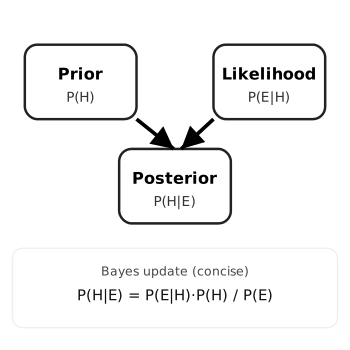
- Bayesian inference is a way to update what you believe about something when you get new data. Start with a prior (your initial guess), observe new evidence, and combine them to produce a posterior (an improved guess). Think of it like updating a probability score for a hypothesis each time you get a new test result. Unlike frequentist methods like maximum likelihood (which only use current data), Bayesian methods explicitly include prior beliefs and give a distribution over possibilities, which makes them useful when data are scarce or when you want a measure of uncertainty.
How does it work?
In practice this means maintaining a probability distribution (the prior), computing how likely new observations are under possible hypotheses (the likelihood), and combining them to form an updated distribution (the posterior). Implementations often work incrementally: observe a batch or a single datum, compute the likelihood, multiply it into the prior and renormalize. Numerical care (log-probabilities) and choice of conjugate priors or sampling methods are common engineering concerns.
Examples
- Medical diagnosis — Probabilistic diagnosis — Combine prior disease prevalence with patient test results to update the probability of conditions in clinical decision support systems.
- Email spam filtering — Compute posterior probability that a message is spam by updating token likelihoods as new labeled messages arrive.
- A/B testing analysis — Incorporate prior expectations and observed conversion data to estimate treatment effects and uncertainty for product experiments.
Problems
- Choosing an inappropriate or overly informative prior that skews results
- Posterior distributions with no closed form, requiring approximation
- Computational cost blowing up as the number of parameters grows
- Difficulty explaining prior/posterior tradeoffs to non-technical stakeholders
- Model misspecification silently producing confidently wrong posteriors