Genetic Algorithm
- Definition
- Genetic Algorithms (GAs) evolve a population of candidate solutions using selection, crossover, and mutation. Over generations, better solutions tend to survive and recombine. S, picture many solutions as a population of strings that mate and mutate so they gradually improve. GAs differ from gradient methods because they don't use derivatives — they explore via population diversity and randomized operators, which helps on rugged or discrete search spaces where gradients don't exist.
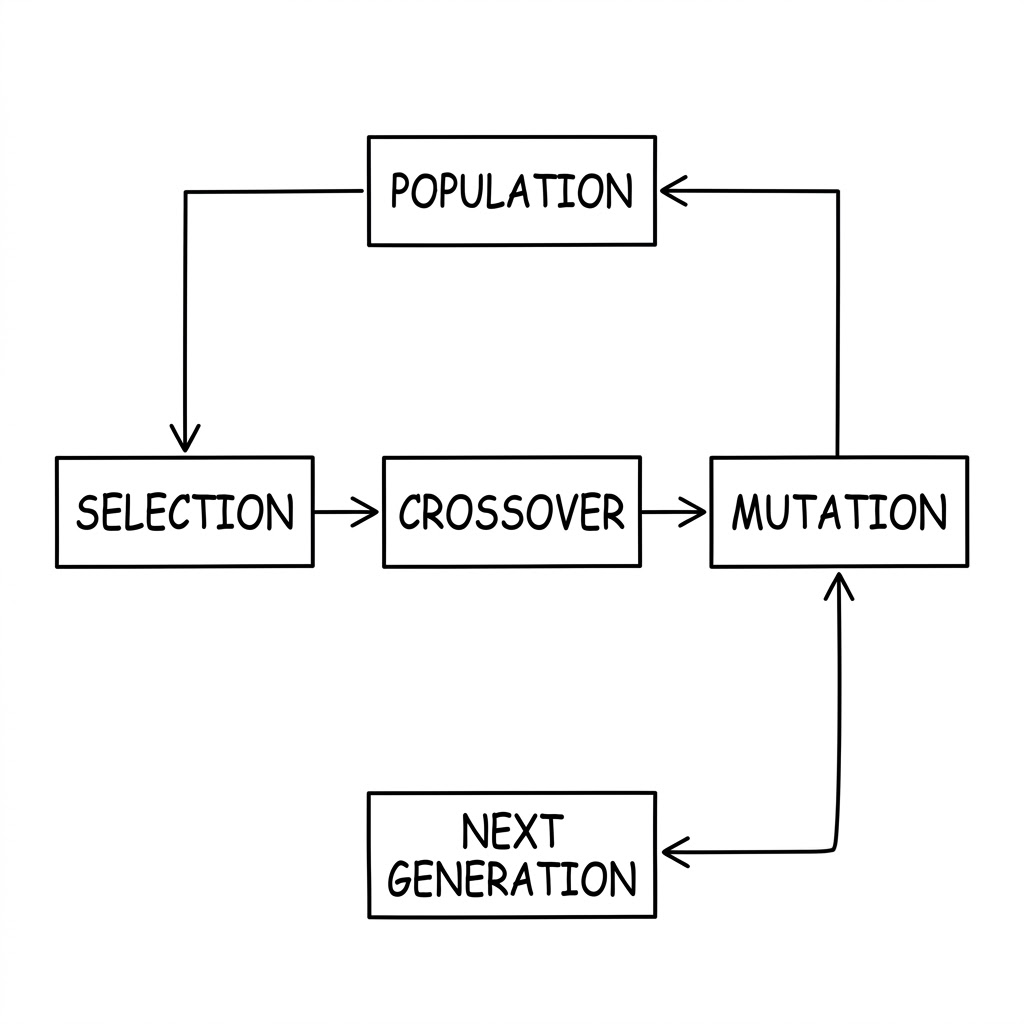
How does it work?
Genetic Algorithm methods maintain a population of candidates and use variation (mutation/crossover) and selection to improve fitness over generations. Implementations manage representation encoding, selection pressure, and diversity to avoid premature convergence; often parallel evaluations are used to speed up fitness computation.
Examples
- Antenna design — Evolve shape parameters to maximise signal characteristics where analytic gradients are unavailable.
- Scheduling optimisation — Evolve candidate schedules with crossover and mutation operators for high-quality timetables.
- Game content generation — Evolve level layouts or parameters for playability and novelty.
Problems
- Premature convergence to a suboptimal population
- Designing effective fitness functions, crossover, and mutation operators
- Expensive fitness evaluation making large populations costly
- Difficulty tuning population size and mutation rate
- No guarantee of finding the global optimum