Brain-computer interface
Brain-computer interface, BCI
- Definition
- A brain-computer interface (BCI) is a direct communication pathway between the brain's electrical activity and an external device, enabling the brain to control or interact with computers or other machinery without involving the body's neuromuscular pathways.
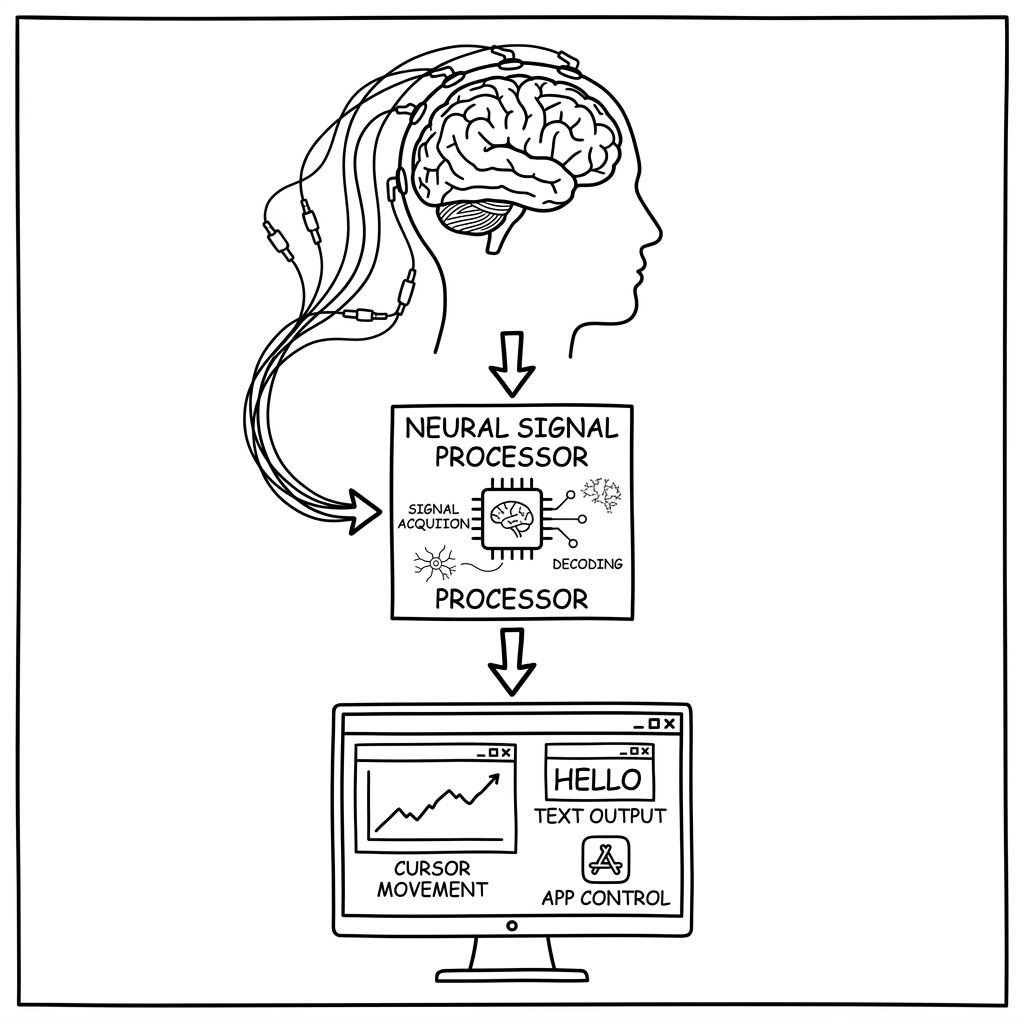
BCIs acquire brain signals, process them to extract meaningful features, and translate those features into device commands. This allows users to control applications, prosthetics, or communicate through thought alone.
The technology can be invasive (implanted electrodes) or non-invasive (EEG-based), and is used in medical rehabilitation, assistive technology, and emerging human-computer interaction paradigms.
Examples
- Controlling a robotic arm using motor imagery signals from the motor cortex.
- Typing on a virtual keyboard by selecting letters through P300 event-related potentials.
- Controlling a wheelchair or smart home environment via steady-state visually evoked potentials (SSVEP).
When should you use it?
- When traditional input methods (keyboard, mouse, touch) are not possible due to motor impairments.
- For creating novel interaction experiences in gaming, virtual reality, or hands-free control.
- In neurorehabilitation to promote neuroplasticity and restore lost motor functions.
- For research into cognitive states, attention, and mental workload monitoring.
How does it work?
The BCI pipeline consists of signal acquisition (electrodes), preprocessing (filtering, artifact removal), feature extraction (e.g., power spectral density, event-related potentials), classification (machine learning algorithms), and device control output. The system adapts to the user's brain patterns through training and feedback.