Automated Theorem Proving
- Definition
- Automated Theorem Proving uses formal logic and search strategies to prove or disprove mathematical statements automatically. Imagine a solver that applies inference rules systematically to derive conclusions from axioms. It differs from heuristic or statistical methods by operating on symbolic, provable correctness rather than probabilistic guesses.
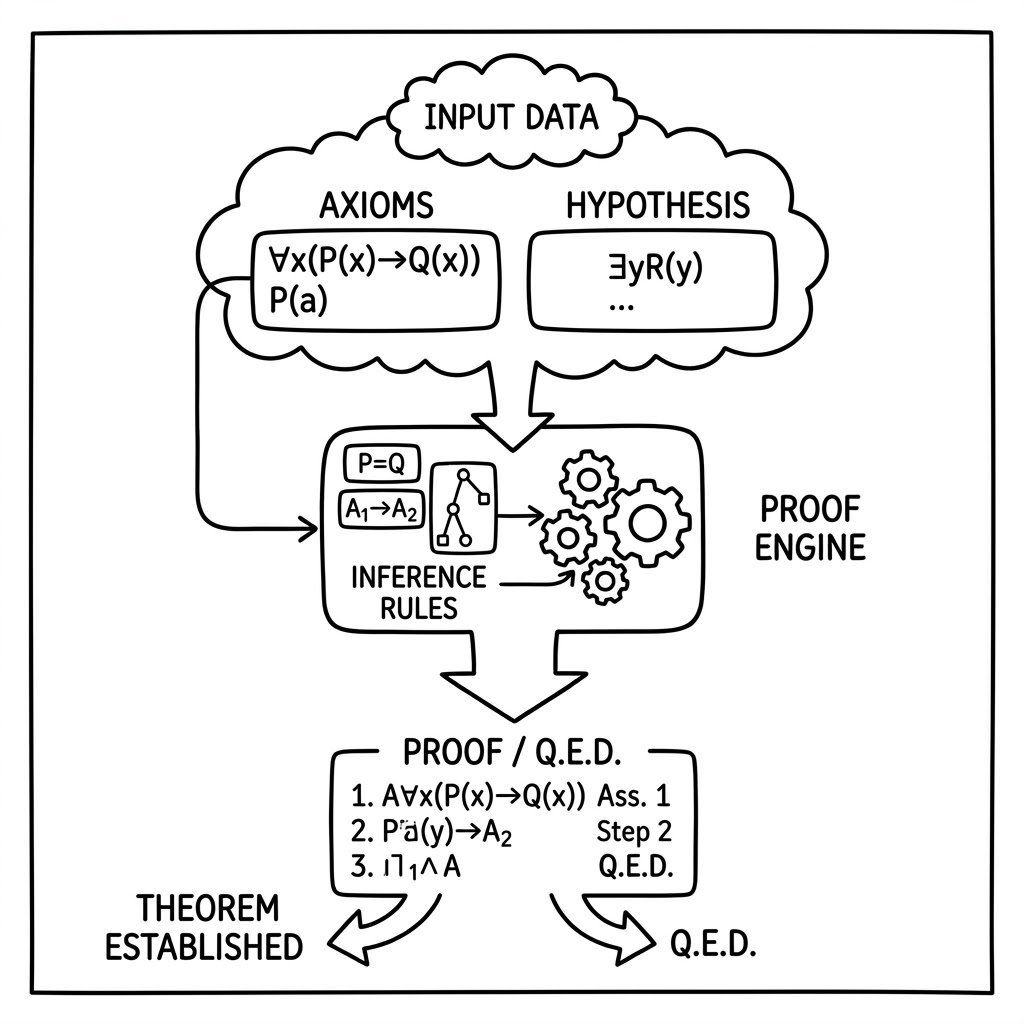
How does it work?
Automated Theorem Proving methods manipulate symbols or rules: represent knowledge explicitly, and apply inference algorithms (forward/backward chaining, constraint propagation, search). Implementations focus on rule ordering, conflict resolution, and efficient indexing of facts.
Examples
- Formal verification of hardware — Prove correctness properties of circuits with automated provers.
- Program verification — Check invariants and prove absence of certain classes of bugs in critical code.
- Mathematical proof search — Assist mathematicians by searching formal proof spaces for lemmas and theorems.
Problems
- Combinatorial explosion of the proof search space
- Many problems are undecidable or intractable in general
- Translating informal problem statements into formal logic is error-prone
- Proof search can be very slow without good heuristics/tactics