Self-Organizing Map
- Definition
- A Self-Organizing Map (SOM) is a neural-network-like method that maps high-dimensional data onto a low-dimensional grid while preserving topology: similar inputs end up near each other. Picture arranging nodes on a grid so that they represent different clusters of the data. SOMs differ from other clustering and embedding techniques by providing a structured grid that can be visualized and interpreted.
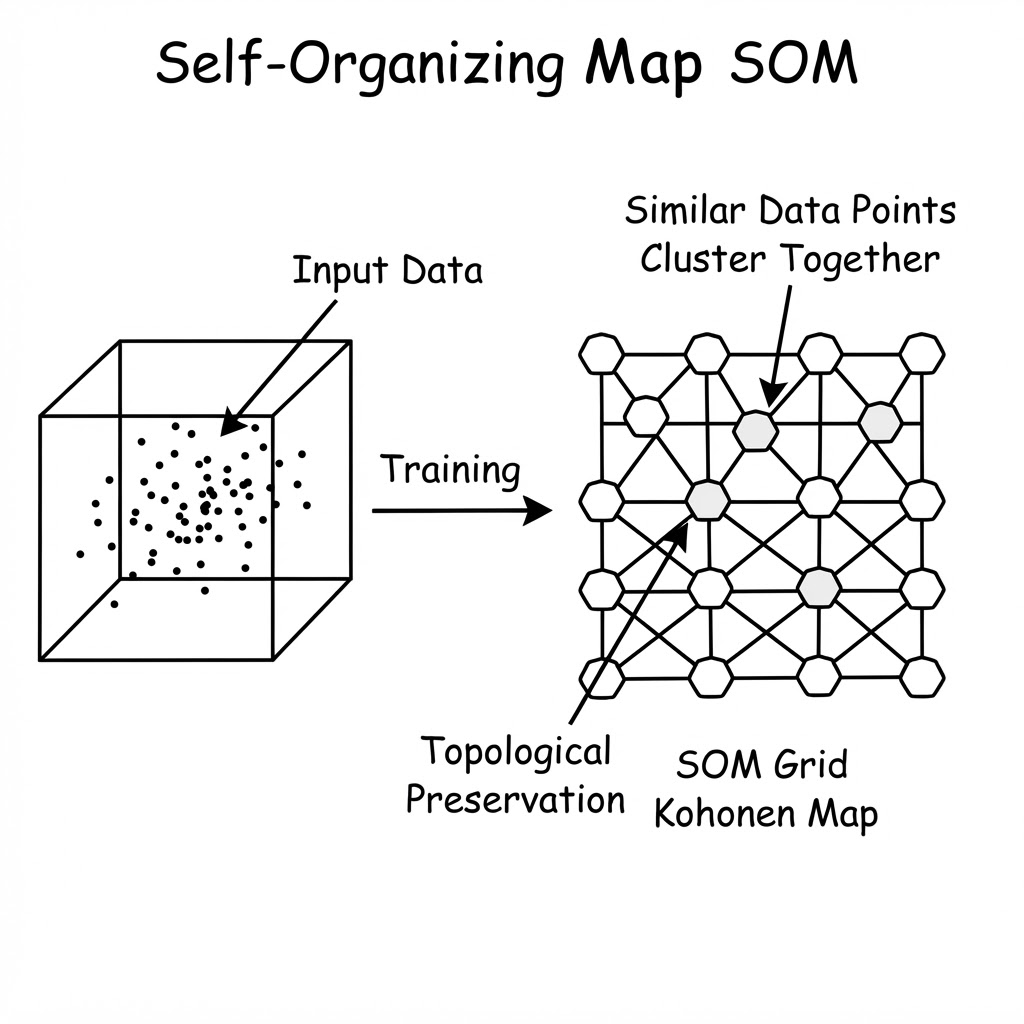
How does it work?
Self-Organizing Map models learn from labeled examples: prepare features, choose a model family, train on examples, and validate on held-out data. Pay attention to data preprocessing, class imbalance, and hyperparameter tuning.
Examples
- Topology-preserving embedding — Map high-dimensional sensory data onto 2D grids for visual analytics.
- Customer behaviour maps — Visual cluster maps that help marketing teams explore segments.
- Anomaly visualisation — Spot unusual input patterns as isolated nodes on the map.
Problems
- Choosing an appropriate map size and topology in advance
- Sensitive to learning rate and neighborhood radius schedules
- Slow to train on large, high-dimensional datasets
- Results can be hard to interpret and validate quantitatively