Expert System
- Definition
- An Expert System encodes human expertise as explicit if-then rules and uses rule engines to make decisions or diagnoses. Think of a large set of condition-action pairs that emulate an expert's reasoning process. Expert systems differ from statistical ML because they rely on explicit rules designed by humans rather than learned from data — they are interpretable but brittle when rules don't cover edge cases.
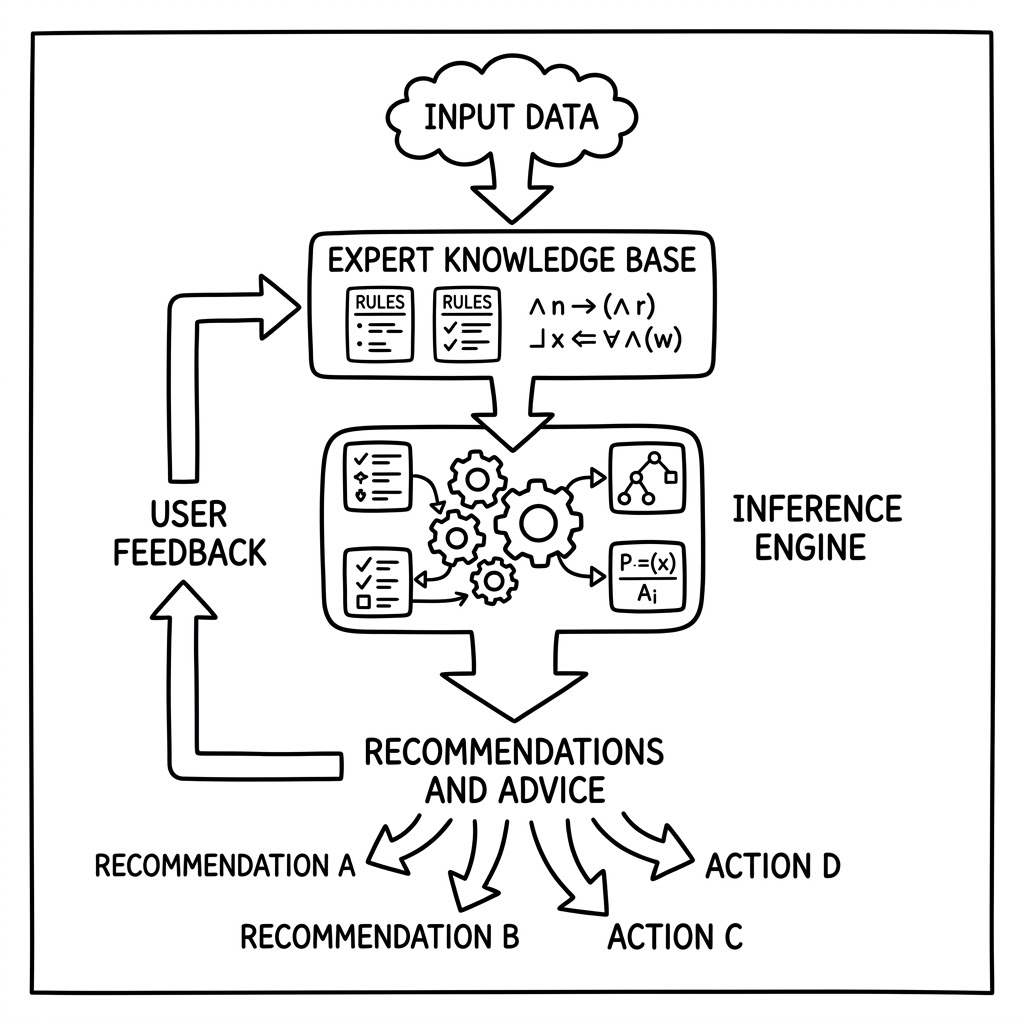
How does it work?
Expert System methods manipulate symbols or rules: represent knowledge explicitly, and apply inference algorithms (forward/backward chaining, constraint propagation, search). Implementations focus on rule ordering, conflict resolution, and efficient indexing of facts.
Examples
- Medical diagnostic checklists — Encode clinical heuristics as rules to provide decision support for common conditions.
- Configuration management — Rule engines that validate system configurations and propose fixes.
- Loan eligibility rules — Deterministic rule sets for initial screening in financial services.
Problems
- Knowledge acquisition bottleneck — capturing expert rules is slow and costly
- Rule base becomes hard to maintain as it grows (rule interactions/conflicts)
- Brittle outside the narrow domain it was designed for
- Doesn't handle uncertainty or novel situations gracefully