Diffusion Model
- Definition
- Diffusion models learn to generate data by reversing a process that gradually corrupts data with noise. The model learns to denoise step by step until a clean sample emerges. Think of learning a multi-step cleanup routine: start with noise and iteratively remove it to create data. Diffusion models differ from GANs by optimizing likelihood-like objectives and tend to be more stable, though often slower at sampling.
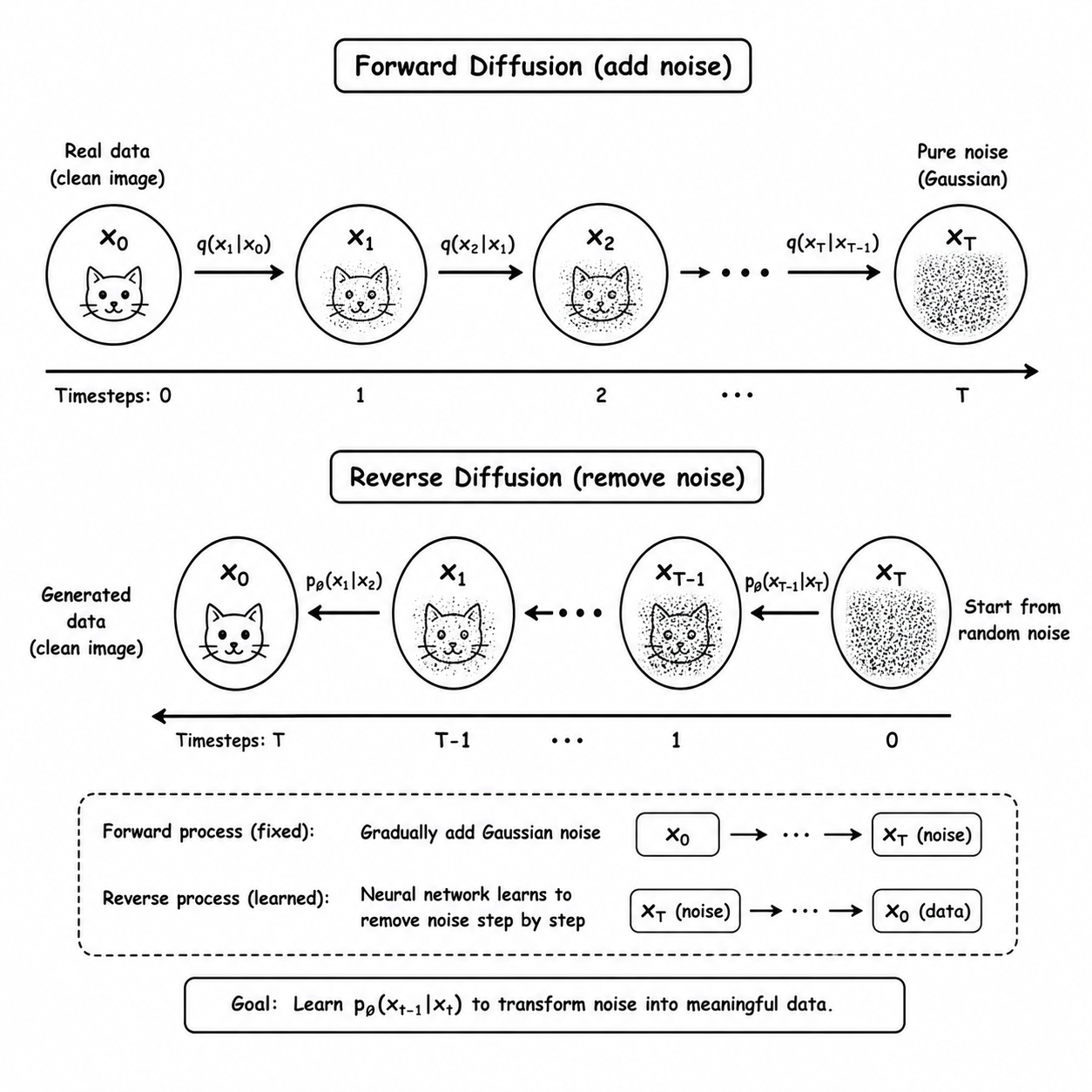
How does it work?
Diffusion Model architectures are specialised neural designs; they define layer types and connectivity that bias the model to particular data structures. Implementations balance depth, width, and compute considerations for practical training.
Examples
- Text-to-image generation — Learn reverse diffusion to generate high-fidelity images from text embeddings.
- Denoising and inpainting — Use diffusion samplers to restore missing or corrupted image regions.
- Audio synthesis — Generate or transform audio waveforms using diffusion-based models for music or speech.
Problems
- Slow sampling requiring many denoising steps
- High computational cost to train and to run inference
- Difficult to control precise attributes of generated output
- Large memory footprint for high-resolution generation